Wording guide
Hindi wedding invitation wording: the shubh vivah card, line by line
By the Wishly team · Updated
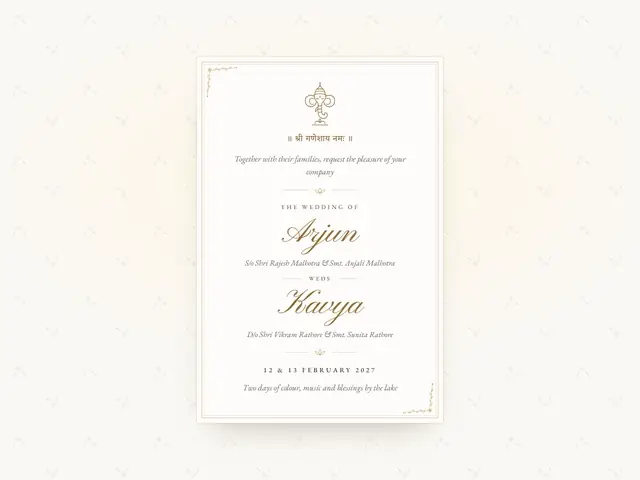
A Hindi wedding card opens with Ganesha's blessing, names the family that invites, then the bride and groom with their parents, the muhurat and the venue, and closes with the relatives who look forward to seeing you. The usual headings are Shubh Vivah and Sasneh Nimantran, the groom is styled Chiranjeev and the bride Ayushmati, and the functions go in a programme of their own.
This guide sets out that order, explains the Hindi words families still print, and gives samples to copy for a formal card from the parents, a couple-hosted invitation, a WhatsApp message and the sangeet.
The order of lines on a Hindi wedding card
North Indian Hindu cards follow a settled sequence, and elders notice when a line is missing or out of place. The card speaks for the family that prints it: the bride's family names their daughter first, and the groom's family names their son first.
- Invocation: a Ganesha with Shri Ganeshaya Namah or the Vakratunda shloka, and sometimes the kuldevi or kuldevta.
- Heading: Shubh Vivah, with Sasneh Nimantran (an affectionate invitation) or Saadar Aamantran (a respectful one) above the text.
- Blessings: the grandparents, living and late, under whose blessings the wedding takes place.
- The couple: Ayushmati before the bride's name and Chiranjeev before the groom's, each with suputri or suputra and their parents' names.
- The muhurat: day, date, time and venue of the pheras.
- Karyakram: the programme, from tilak or haldi to mehndi, sangeet, baraat, jaimala, pheras, preetibhoj and vidaai.
- Darshanabhilashi: the relatives eager to see you, often followed by the bal manuhar, a line from the children of the family.
- Vinit, the humble hosts, with phone numbers for replies.
Formal Hindi wording from the parents
This is the classic shape in Hindi, written in Latin letters, from the bride's parents. For a card from the groom's side, name his parents first and change suputri to suputra.
Shri Ganeshaya Namah
Sasneh Nimantran
Shrimati Sunita evam Shri Rajesh Sharma ki suputri
Ayushmati Priya
ka shubh vivah
Chiranjeev Rahul
(suputra Shrimati Meena evam Shri Anil Verma, Jaipur)
ke saath Shukravar, 12 February 2027 ko hona nishchit hua hai.
Is mangal avsar par aap saparivar saadar aamantrit hain.
Vinit: Sharma parivar
What it says: Salutation to Lord Ganesha. An affectionate invitation. The wedding of Priya, daughter of Mrs Sunita and Mr Rajesh Sharma, to Rahul, son of Mrs Meena and Mr Anil Verma of Jaipur, has been fixed for Friday, 12 February 2027. You and your family are respectfully invited on this auspicious occasion. Humbly, the Sharma family.
Haldi: Thursday, 11 February, 10 am
Mehndi and sangeet: Thursday, 11 February, from 6 pm
Baraat aagman: Friday, 12 February, 8 pm
Jaimala: 9 pm, followed by the preetibhoj
Pheras: 11 pm
Vidaai: Saturday, 13 February, early morning
What it says: Baraat aagman is the arrival of the groom's procession; preetibhoj is the wedding dinner.
The shloka at the top of the card
The Vakratunda shloka asks Ganesha to keep every undertaking free of obstacles, which is why it heads so many cards. Some families print the Mangalam Bhagwan Vishnu shloka instead, and others only their kuldevi's name; ask the eldest of the family, because this is a matter of household custom.
Vakratunda Mahakaya Suryakoti Samaprabha
Nirvighnam Kuru Me Deva Sarva Karyeshu Sarvada
What it says: O Lord of the curved trunk and mighty form, radiant as ten million suns, keep all my undertakings free of obstacles, always.
Couple-hosted and modern Hindi wording
More couples now invite in their own names, particularly when they live away from home or are hosting the wedding themselves. Keeping both families in the opening line keeps the elders comfortable.
Together with our families,
Priya Sharma and Rahul Verma
invite you to our wedding
on Friday, 12 February 2027, in Jaipur
Haldi, mehndi and sangeet on Thursday; pheras on Friday night
Come for the blessings, stay for the dancing.
WhatsApp and single functions
Put the names, the date and the city in the first two lines of a WhatsApp message, because many relatives read only the notification. A function with its own guest list, such as the sangeet, deserves a message of its own.
Shubh Vivah: Priya weds Rahul
Friday, 12 February 2027, Jaipur
The functions, the venue map and the reply button are all in the invitation:
[link]
Aapke aashirwad ka intezaar rahega.
What it says: The last line means: we will be waiting for your blessings.
Sangeet Sandhya
Priya aur Rahul ki shaadi se pehle naach-gaane ki ek shaam
Thursday, 11 February 2027, from 6 pm
[venue], Jaipur
Bright colours, comfortable shoes
What it says: Sangeet evening: an evening of song and dance before Priya and Rahul's wedding.
Hamari didi ki shaadi mein zaroor-zaroor aana!
Aarav and Pihu
What it says: Do, do come to our sister's wedding! From Aarav and Pihu.
Etiquette for a Hindi wedding invitation
The invitation is issued by the head of the household, who may be a grandfather rather than the father; in a joint family his name goes in the hosting line. Late grandparents are remembered with Swargiya, meaning the late, before their names, or with a line saying the wedding takes place with their blessings.
The first card is offered to Ganesha, at home or at a temple, before any guest receives one. Elders and close relatives still expect their card by hand, often with a box of sweets, so keep a printed batch for them and send the link to everyone else.
- Send save the dates as soon as the date and city are fixed if guests must travel, and the invitation about a month before.
- Print the time of the pheras even when it falls late at night; guests who come only for the blessings plan around it.
- Name one person for replies, often a brother or a cousin, and give a reply-by date.
Questions families ask
- Should a Hindi card say Sasneh Nimantran or Shubh Vivah?
- Many cards use both: Shubh Vivah as the heading and Sasneh Nimantran over the invitation itself. Saadar Aamantran is the more formal choice for elders and senior colleagues.
- What do Chiranjeev and Ayushmati mean?
- Both are wishes for a long life written before a name: Chiranjeev for the groom and Ayushmati for the bride. Chiranjeev is often shortened to Chi.
- Can the card be in Hindi and English together?
- Yes, and it often is: Hindi for the invocation, the hosting line and the names, and English for dates, venues, the programme and replies, which guests from other states read faster.