How-to
Digital vs printed wedding invitations: an honest comparison for Indian weddings
By the Wishly team · Updated
Digital invitations are quicker to make, reach every guest at once, can be corrected after sending and collect replies, while printed cards carry ritual weight, suit elders and are kept as keepsakes. Many Indian families now do both: a small print run for the puja and the elders, and a link for everyone.
Here is the comparison point by point, on time, changes, reach, replies, elders and keepsakes, and how to combine the two.
At a glance
Neither is right for every family; the trade-offs are different in kind, and they fall like this.
- Time: print needs proofs, printing and delivery; a digital invitation is ready in a day or two.
- Changes: print needs a reprint or a round of calls; a link is updated in place.
- Reach: print travels by hand or courier; a link reaches anyone with a phone.
- Replies: print relies on calls; a digital invitation gathers them in one list.
- Elders and ritual: print is part of the custom; a link alone can feel casual.
- Keepsake: print is something to hold; a digital invitation keeps the blessings guests leave on it.
Time
A printed card needs a design, proofs, printing and delivery, and every round of corrections adds days; families who hand-deliver also spend weekends on visits. A digital invitation can be ready in a day or two once the details are in, and it reaches every guest in an afternoon.
Changes after sending
Plans change: a venue moves, a function is added, the priest corrects a time. On paper, a change means a reprint or a round of phone calls, and some guests will still follow the old card. A digital invitation is updated at the same link, so a guest who opens it on the day sees the latest details.
Reach
Printed cards travel by hand or by courier, and couriers abroad are slow, so relatives overseas often get a photo of the card on WhatsApp anyway. A link reaches a cousin in Toronto as quickly as a neighbour, and the map, the timings and the reply come with it.
Replies
A printed card leaves replies to phone calls and memory. A digital invitation can collect each reply with the number of guests and their food preferences, and on some designs which functions they will attend, so the list is ready for the caterer.
What it costs, in kind
Print costs grow with every card: paper, printing, envelopes, the sweets that travel with them and the couriers, so a long guest list multiplies all of it. A digital invitation is one piece of work whatever the size of the list, and sending it to one more guest costs nothing. What print buys is the object and the visit, which no link replaces.
What guests do with each
A printed card goes on the fridge or the puja shelf, and guests check it for the date and the venue, but it cannot show them the way. A link sits in the chat where they can find it on the day; it opens the map, adds each function to the phone's calendar and counts down to the wedding.
Elders, ritual and keepsakes
A printed card has a place in the ritual that a link does not: the first card is offered to the deity, and elders are invited in person with sweets. Some elders find links hard to open, and many families keep their wedding card in an album for decades.
A digital invitation has keepsakes of its own, such as the blessings guests write on it, but it is not something to hold. If the card itself matters to your family, print it.
When to do both
The common answer is a small print run and a link for everyone. Print for the puja, for grandparents and elders, and for relatives you will visit; send the link to every guest, including those who received a card, because the link carries the maps, the replies and any changes.
- Print a QR code of the link inside the paper card, so the two stay connected.
- Keep the wording the same on both, so nobody compares them and finds a difference.
- Finalise the digital invitation first and print from it, so that the details match.
Questions families ask
- Are digital invitations acceptable for Indian weddings?
- Yes, for friends, colleagues and the wider family, and they are now common. Families still give printed cards or a personal call to elders, which keeps everyone comfortable.
- Is a digital invitation kinder to the environment?
- It uses no paper, ink or courier, so it avoids the waste of a large print run. If you do both, a small print run for elders keeps that waste low.
- How far ahead should printed cards be ordered?
- Start at least a month before you plan to send them, to allow for proofs, printing and delivery. Settle the wording in the digital invitation first and print from it.
- Can a digital invitation look like a traditional card?
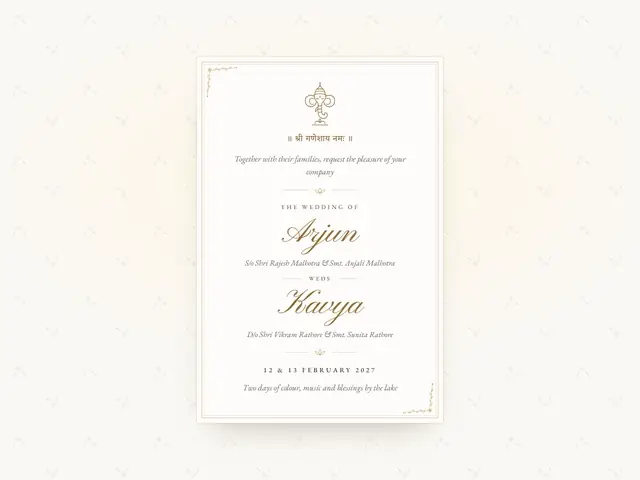
- Yes. Many designs open with an envelope, a wax seal or a printed-card layout, and carry the same invocation and family lines a printed card has.